
A pivot point
Germany's shift a century ago offers troubling lessons about how democracies fall

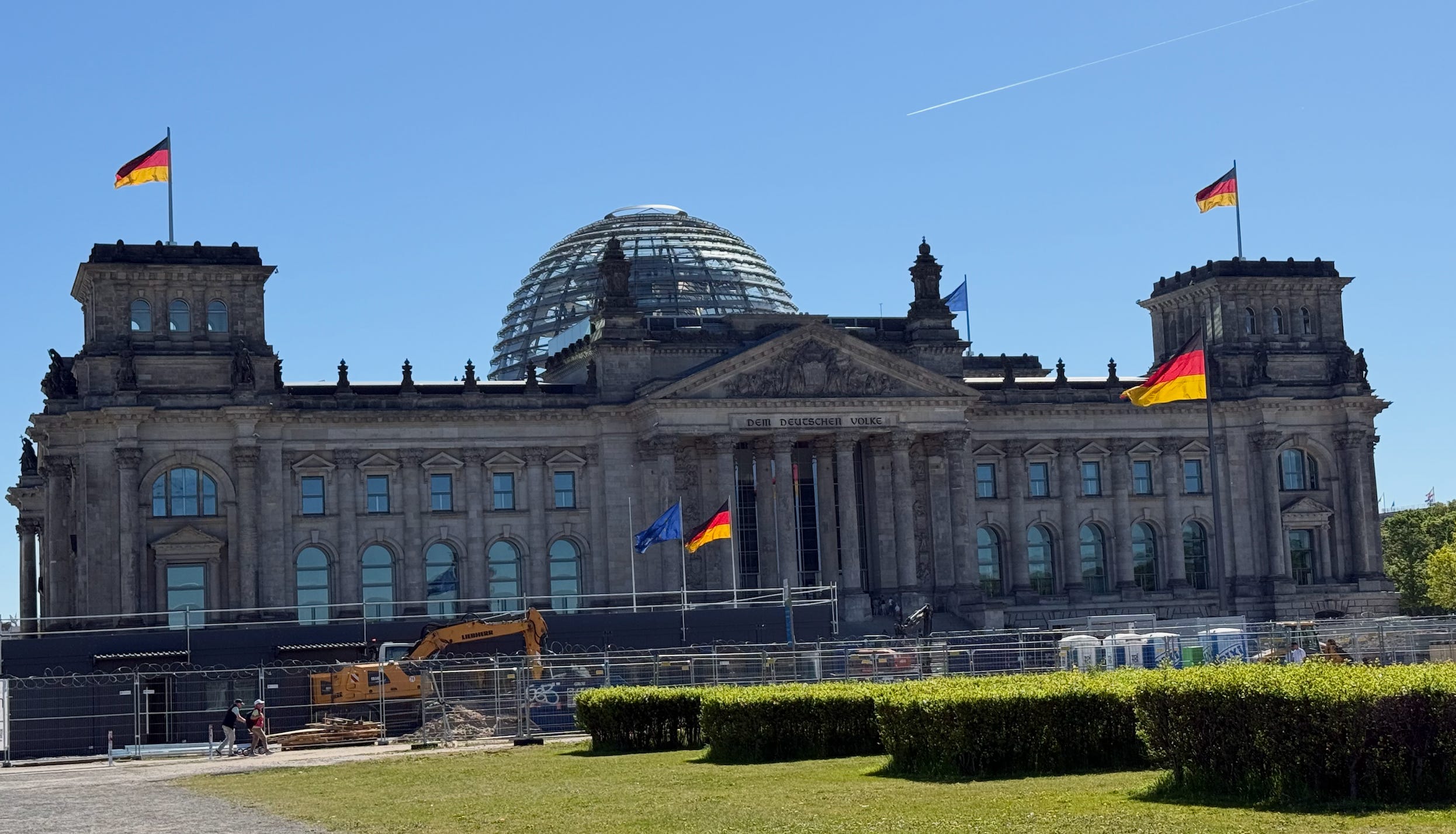
As we stood outside the Reichstag building in Berlin recently, the well-schooled guide who showed us the city’s major WWII sites spelled out the way Adolf Hitler and his cronies came to power. Today, nearly a century on, their techniques sound all too distressingly familiar.
The Nazis’ key tactics in the 1930s included scapegoating immigrants, Jews, Communists and others for the nation’s economic woes. They invoked a mythical Aryanism, saying they wanted to keep pure the blood and soil of the German nation – racist terms they frequently used. They promised to end ravaging inflation. In short, they promised to make Germany great again.
The desperate German public, suffering acutely in the global Great Depression, ate it up. Over several elections, by mid-1932, they voted in a large minority of seats for the once-fringe Nazi Party. Then, in early 1933, Hitler pressed 85-year-old German President Paul von Hindenburg to name him Chancellor in a coalition government. Hitler sidelined then ultimately jailed his political opponents.
Of course, that wasn’t enough. So, after a mysterious fire in the Reichstag – the seat of the German legislature – Hitler persuaded von Hindenberg to sign the Reichstag Fire Degree, gutting the German constitution. “The decree permitted the restriction of the right to assembly, freedom of speech, and freedom of the press, among other rights, and it removed all restraints on police investigations,” as the U.S. Holocaust Museum’s encyclopedia records.
“With the decree in place, the regime was free to arrest and incarcerate political opponents without specific charge, dissolve political organizations, and suppress publications,” the account continues. “It also gave the central government the authority to overrule state and local laws and overthrow state and local governments. This law became a permanent feature of the Nazi police state.”
Through that, the monomaniacal Hitler assumed the power of a dictator, ending Germany’s short post-WWI experiment in democracy. As he sought to expand his empire far beyond its national boundaries, he led the country into a devastating war. And he wound up ending his life in 1945 in an underground Berlin bunker with his city in ruins.
So, today, we have another monomaniac determined to expand the reach of his country, the United States – either politically by acquiring Greenland or Canada or militarily à la Venezuela and Iran. Donald J. Trump has led us into a war that seems mostly to have blown up in his face. He has scapegoated immigrants, detaining or deporting tens of thousands and claiming they are “poisoning the blood of our country.” And he is using techniques that echo Hitler’s.
History may not be repeating itself exactly, but it seems to be rhyming (to cite a comment often attributed to Mark Twain),
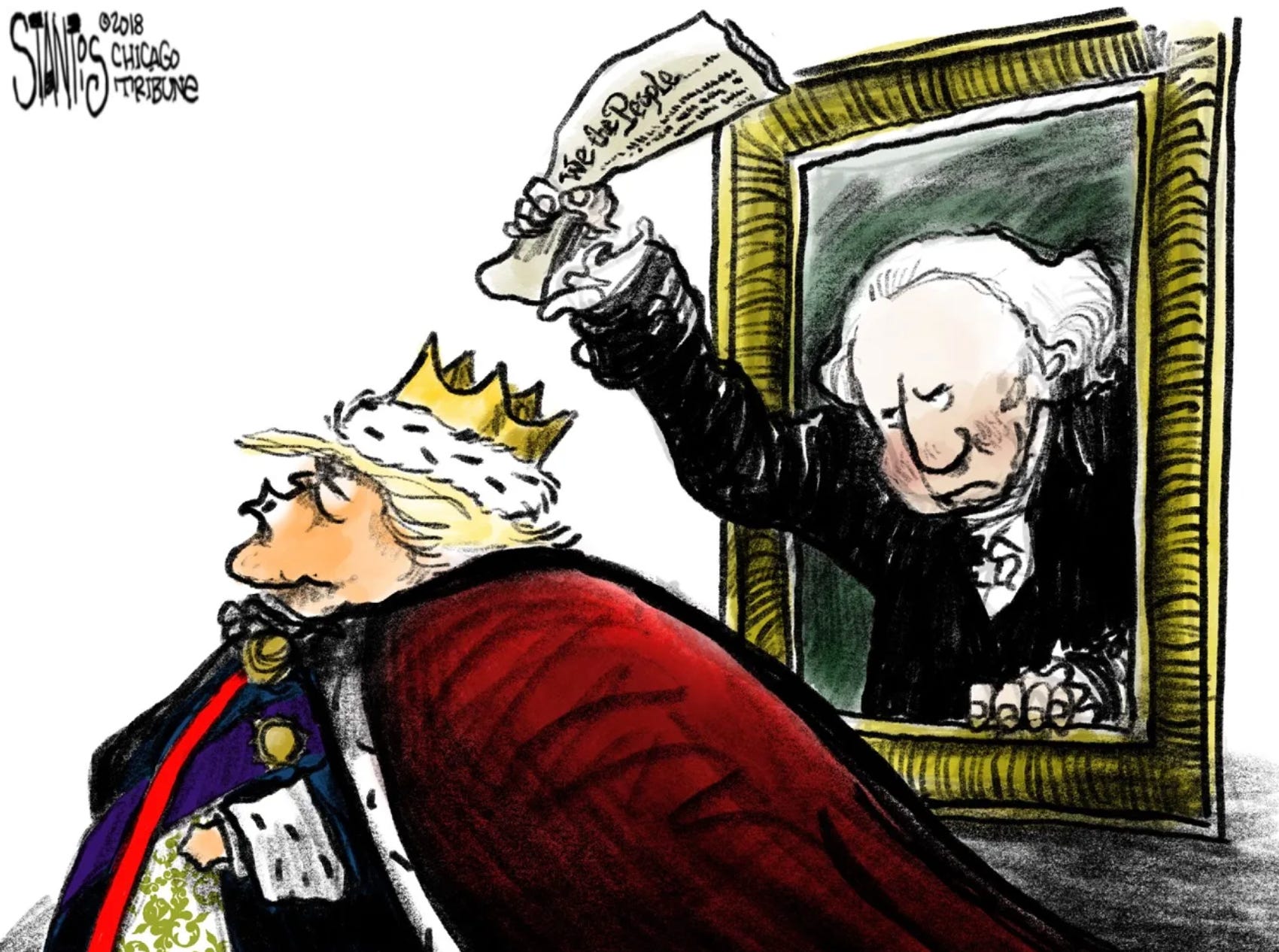
While bending such agencies as the Department of Justice to his will, Trump controls a submissive legislature and wields exceptional influence on the Supreme Court. He and his followers in state governments have sought electoral changes that could compromise elections for years. And he has tried – so far only partly successfully – to stifle the critical press, almost daily filling the airwaves with misinformation.
Trump’s war on the press has a long history, but he and his minions come up with fresh battlegrounds regularly. The president’s Equal Employment Opportunity Commission just sued The New York Times, for instance, claiming the paper had engaged in “unlawful employment practices” and had discriminated against a white male employee denied a promotion. Trump’s Federal Communications Commission on April 28 ordered a review of station licenses owned by ABC, saying it was prompted by an investigation into the network’s diversity and inclusion policies, though the action also followed calls by the president to fire Jimmy Kimmel after he took offense at a joke by the comedian.
Trump has repeatedly sued news outlets, sometimes extracting legal settlements. Encouragingly, he has lost several times, with courts dismissing his suits. That happened with The Wall Street Journal, The Washington Post and CNN, for instance. A judge also dismissed a $15 billion case the president brought against The New York Times, though gave him leave to refile, which he has done.
The president or his toadies have also barred reporters at times from areas such as the Oval Office and the Pentagon. Courts have ruled against such limits, however. Federal courts have also set back the Justice Department’s investigation of a Washington Post reporter whose home federal agents raided in January as they tried to ferret out her sources on stories about Venezuela.
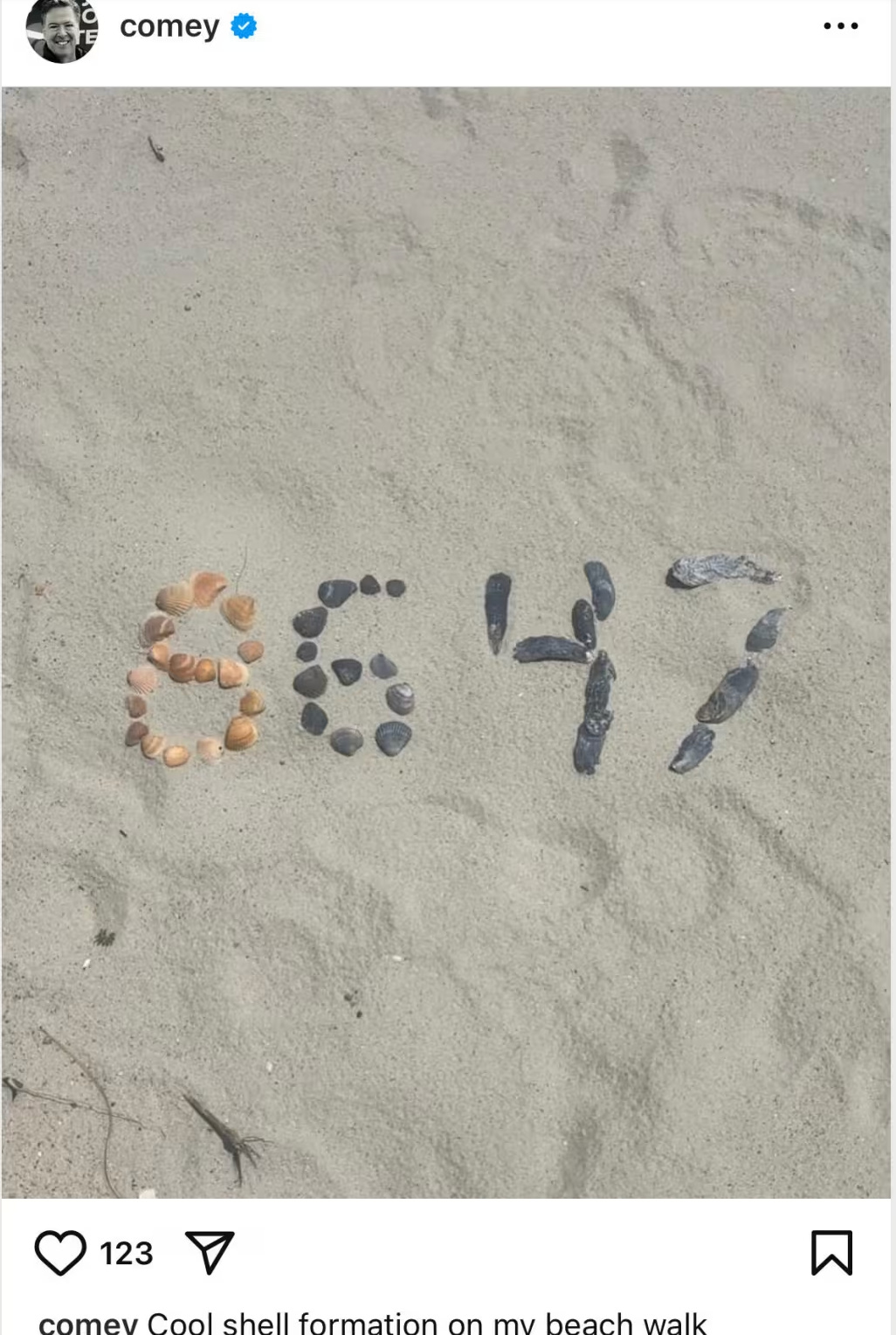
Trump also has vindictively pursued political opponents, using the machinery of the state to advance his grudges. Latest case in point: James Comey’s seashellgate. “Is it plausible that … a former federal prosecutor, deputy attorney general, and FBI director, publicly threatened to murder President Donald Trump?,” asks libertarian Reason magazine. “No, it is not. But that is what W. Ellis Boyle, the U.S. attorney for the Eastern District of North Carolina, claims in an indictment filed on April 28.”
On our Berlin trip, a second well-schooled guide suggested that such efforts are textbook cases in how politicians manipulate the system. They do so, he argued, for self-enrichment — which Trump and his family are very much about, as a Pulitzer Prize-winning series of stories by The New York Times demonstrates — and to entrench their parties.
Some worried U.S. analysts agree:
“American democracy is gone—not under siege, not threatened, but vanquished, with a generous assist from a 2024 electorate that endorsed (wittingly or otherwise) the institution-wrecking that is on display every day in Washington,” Roosevelt University Professor David Faris argued last August in The Nation. Democrats, he adds, “need to understand that their task is not to defend an imperiled democracy but to prevent the GOP from further consolidating the autocracy that its craven politicians, reactionary intellectuals, complicit judges, and guileless voters have imagined for more than two decades and have finally put into practice …”
Discussing the “erosion” of American democracy, Brookings senior fellow Vanessa Williamson bemoaned a slide that she argued predates Trump. The anti-democratic moves have stretched from manipulative state legislatures to Washington.
“Since 2010, state legislatures have instituted laws intended to reduce voters’ access to the ballot, politicize election administration, and foreclose electoral competition via extreme gerrymandering,” the Brookings scholar maintains. “The United States has also seen substantial expansions of executive power and serious efforts to erode the independence of the civil service. Against these pressures, the gridlocked and hyperpartisan Congress is poorly equipped to provide unbiased oversight and accountability of the executive, and there are serious questions about the impartiality of the judiciary.”
But is the game really up yet? So far, many courts — short of the Supreme Court — have stood in the way of Trump’s overreaches.
And, even with all the manipulations and threats by Trump and his supporters in various states, the midterm elections in November could strip the president and his party of much of the power they have seized. As New York Times columnist Bret Stephens has written, as of early May, the Polymarket prediction market gives the Democrats a 51 percent chance of winning the Senate and an 83 percent chance of taking the House.
Contrary to general impressions about Trump’s hold on much of the public, the president lately is proving to be an albatross on the neck of his party. An ABC News/Washington Post poll released Sunday found that just 37 percent of Americans approve of his performance and 62 percent disapprove. “The war on Iran and its effects on prices at home — particularly at the gas pump — are pushing Trump’s ratings down,” The Hill reported.
Other polls concur. “In the polling average maintained by The Hill’s data partner, Decision Desk HQ (DDHQ), Trump is 17 points underwater, with 56.9 percent disapproving and 39.7 percent approving of his job performance. Nate Silver’s Silver Bulletin has Trump almost 19 points in negative territory — a deficit 8 points larger than where it stood at the start of the year. And, in the RealClearPolitics (RCP) average, Trump is 16 points underwater.
Of course, such general nationwide sentiments aren’t decisive. After all, Trump won with a minority of the popular vote, 49.8 percent, claiming a landslide by snaring 312 Electoral College votes to Kamala Harris’s 226. Great swaths of red cloud the Democrats’ prospects:
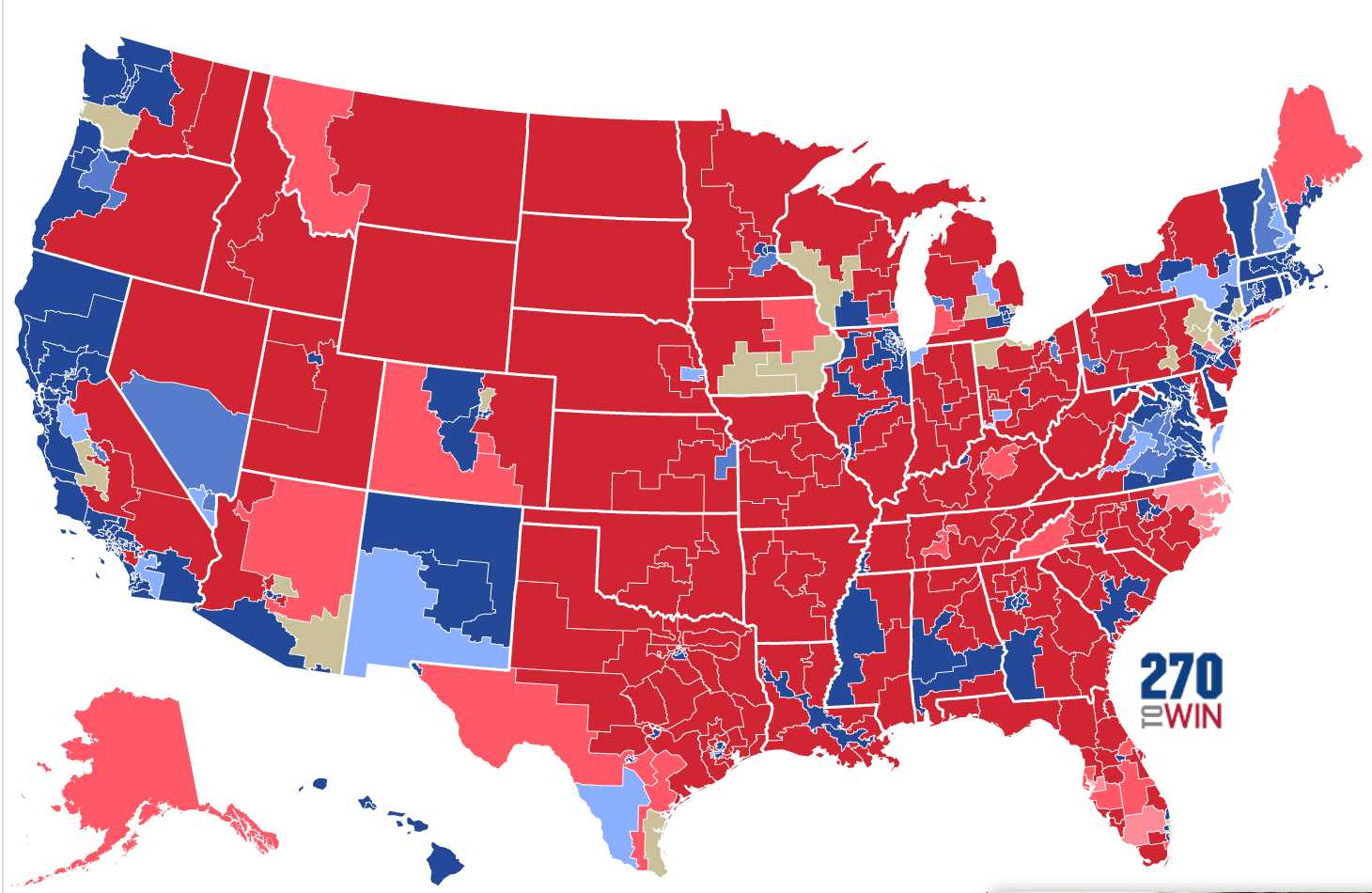
The Republican-dominated Supreme Court didn’t help the Democratic case with its recent further gutting of voting rights. In Louisiana v. Callais, the court struck down a Louisiana congressional map that a group of self-styled “non-African American” voters had challenged. The move barred the state from using a map that had created a majority-Black district, and accelerated the gerrymandering war Trump launched months ago.
“The Republicans on the Supreme Court have put the final nail in the coffin of the 1965 Voting Rights Act,” contends political scientist Fr. Thomas Reese. “Justices who claim to prize historical intent now interpret post-Civil War amendments to the Constitution as a defense of white rights.”
And yet, despite the all-too-real threats to democracy and the erosions we’ve seen, the Iran War debacle and its ability to hit Americans in their wallets could prove to be the undoing of the Trumpian forces. The election is six months away, so anything could happen, but some experts on authoritarianism are less dour than others.
Steven Levitsky, Lucan A. Way, and Daniel Ziblatt, professors who fret about the “competitive authoritarianism” the U.S. has slipped into, hold that democracy hasn’t yet fallen. “The fact that the United States has crossed the line into competitive authoritarianism does not mean that its democratic decline has reached a point of no return,” they argue in Foreign Affairs. “Trump’s authoritarian offensive is now unmistakable, but it is reversible.”
Yes, they say, it’s true that in 2025, the United States ceased to be a full democracy in the way that Canada, Germany, or even Argentina are democracies. But “as the Democratic Party’s success in the November 2025 elections shows, multiple channels remain through which opposition forces can contest—and potentially defeat—Trump’s increasingly authoritarian government.”
Trump, already showing signs of dementia, will be 82 when his term ends in January 2029. So, even though he has made noises about seeking a third term, it’s unlikely he’ll carry his party’s mantle again.
But others — notably Vice President JD Vance and Secretary of State Marco Rubio — seem hungry to do so. Their GOP backers certainly will try to cement the party’s control of Washington, whatever the cost.
It’s possible that Trump and his minions could be salvaged by some dramatic development akin to the Reichstag fire of 1933. It may be foolish to put staging something like that past them.
For now, though, we seem near a pivot point that either will prove the pessimists right or will bring American democracy back from the brink. The choice we all face six months hence is every bit as consequential as that Germans faced nearly a century ago.